
Most teams still treat direct traffic as if it means one simple thing: someone knew where they were going and arrived on purpose.
Sometimes that is true. Often it is not.
Direct traffic is one of those channel labels that looks cleaner than it really is. It can include genuine direct visits, but it can also hide traffic from private sharing, app-internal browsers, missing referrer data, privacy tools, and links clicked from places analytics platforms struggle to interpret properly.
That matters because if you take the label too literally, you start making the wrong assumptions about what is actually driving this traffic.

1. Stop treating direct traffic as literal
The first shift is interpretive, not technical.
When you see direct traffic in a report, do not assume it means typed URL, bookmark, or brand familiarity by default. Sometimes it does. But if you are seeing first-time visits landing on long, specific URLs, that should already tell you something else is going on.
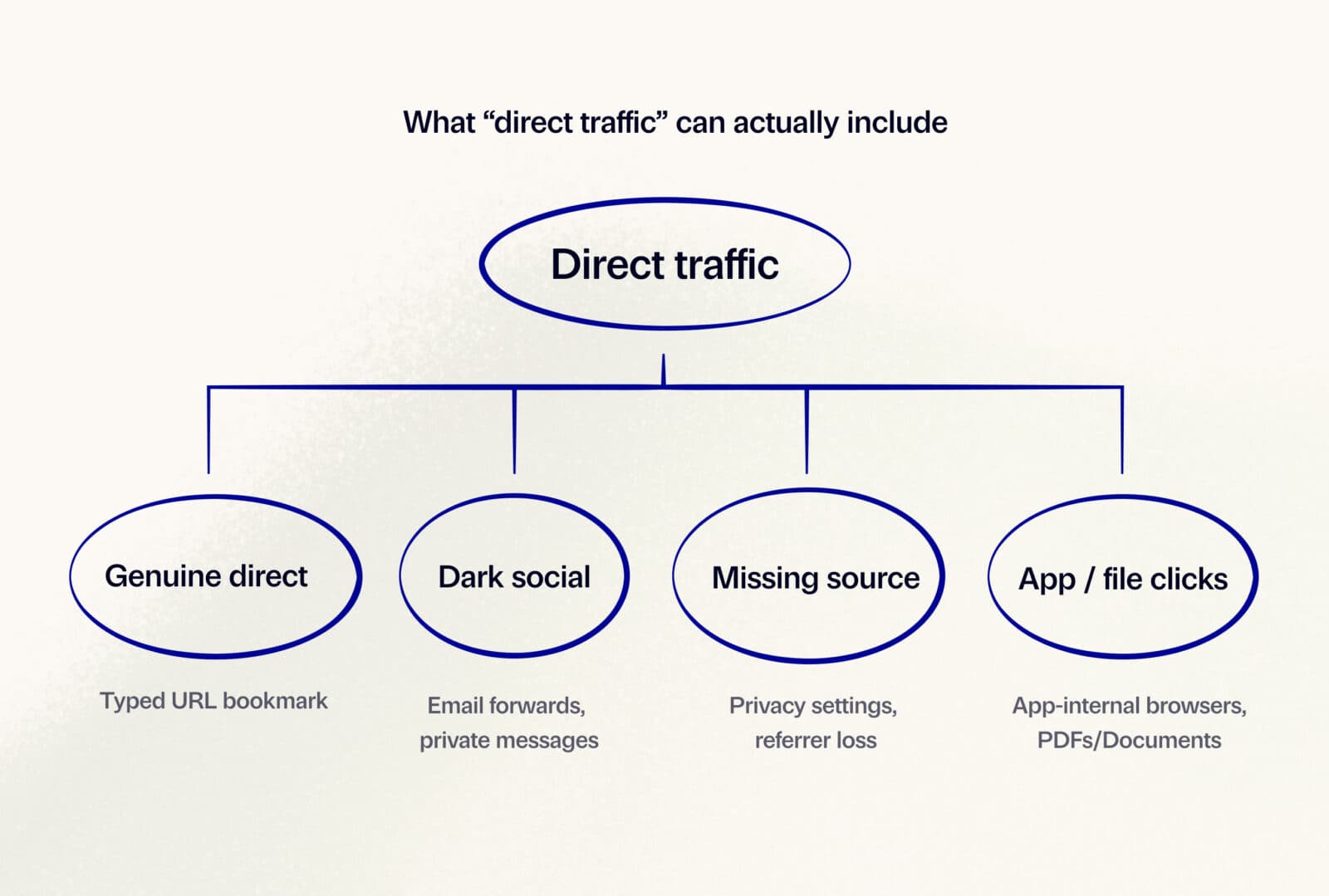
In practice, direct traffic is often a mixed bucket. It can include:
- genuine direct entry
- links shared through email, messaging apps like WhatsApp, or other private channels
- visits where browser privacy features stripped referral data
- app-internal browser clicks that failed to pass source information properly
- links from PDFs, documents, or other offline files
The mistake to avoid here is treating direct traffic as a behavioural truth when it is often just a reporting leftover. The more useful question is not “How many people came directly?” but “What kinds of traffic are likely being collapsed into this bucket?”
2. Tighten UTM discipline everywhere you actually control
If direct traffic is swallowing campaign visits that should be attributable, the first place to look is not the platform. It is your own hygiene.
Robust UTM tagging is still the simplest and most effective way to stop owned traffic disappearing into direct. Email newsletters, social posts, partnership links, campaign assets, PDFs, downloadable documents, and any deliberately distributed links should be tagged clearly and consistently.
This is not glamorous work, but it matters. Every untagged campaign link creates unnecessary ambiguity later. Teams often treat UTM discipline as admin. It is closer to measurement infrastructure.
The mistake to avoid is assuming that analytics tools will fill in the gaps for you. They will not. If a source is controllable, tag it properly before it leaves your hands.
3. Use landing-page patterns to work out what "direct" probably means
One of the easiest ways to make direct traffic more useful is to stop staring at the channel label and start looking at where those sessions actually land.
If large numbers of direct visits are arriving on your homepage, that may well include genuine direct behaviour. If they are regularly arriving on deep blog posts, product pages, or long campaign URLs, that is a different signal. People are unlikely to be typing those paths manually. Something else is happening, whether that is dark social, copied links, app sharing, or lost referral data.
This is where direct traffic becomes less of a mystery and more of an investigation. Landing-page review helps you move from abstract reporting to plausible explanation.
The mistake to avoid is asking the report to tell you more than it can. Sometimes the better move is to infer intelligently from the shape of the traffic rather than waiting for certainty that will never arrive.
4. Separate tracking gaps from real user behaviour
Not all direct traffic problems come from the same place.
Some really are behavioural. A user may know your brand, bookmark a page, or return directly. Other visits are effectively unlabeled because something stripped the referrer on the way through. That might be browser privacy settings, ad blockers, HTTPS-to-HTTP transitions, app-based browsing environments, or links opened from offline files.
Why does this distinction matter? Because the response is different.
If the issue is genuine direct behaviour, the question becomes what is driving enough familiarity or intent for that to happen. If the issue is source loss, the question becomes where are your tracking or reporting assumptions breaking down.
The mistake to avoid is treating all direct traffic as one diagnosis. It is one label, but often several underlying causes.
5. Build confidence from context, not a single report
The final shift is mindset.
You won’t make direct traffic perfectly clear—especially in a privacy-first world. What you can do is reduce ambiguity by combining signals: tagged links, landing page patterns, event tracking, journey analysis, and even user feedback.
Clues matter. A spike in “direct” to a deep page after an email send, or users saying they came via a shared link—these all add context. Better reporting comes from interpretation, not just export.
The key mistake is expecting one report to hold the full truth. Direct traffic works best when treated not as a precise channel, but as a signal.
Where this breaks down
There is a limit to how clean this gets.
Privacy changes, browser behaviour, app environments, and reporting constraints mean some traffic will always arrive with incomplete source information. Better UTM discipline and sharper analysis can reduce the size of the unknown, but they will not remove it entirely.
That is worth being honest about, because the wrong goal creates the wrong behaviour. If you are chasing perfect clarity, you will spend a lot of time trying to solve for something that the environment no longer reliably allows. The better goal is to make direct traffic less ambiguous and your decisions more informed.
The takeaway
Direct traffic is not useless. It is just less literal than many teams want it to be.
The useful shift is to stop asking it for a clean story and start asking better questions about what it is likely hiding. Tighten what you can control, look harder at where those sessions land, and accept that some ambiguity is now part of the landscape.
We have found that teams get more value from direct traffic when they treat it as a prompt for investigation, not a final answer.
Explore more
The Drive-Thru Test for Website Navigation
What drive-thru menus reveal about clearer website navigation—and how labels, hierarchy and entry context help visitors confidently choose their next step.
Google Wants Your Property Listings
As Google moves further into property discovery, owned websites still matter for buyer confidence and better enquiries.

Headless Architecture Is Really About Adaptability
Headless architecture separates content from presentation, helping digital platforms adapt across websites, campaigns and customer touchpoints.