
Most rebuild conversations start with the visible part of the website.
What should it look like? What should it do? What will it cost?
Those questions matter. A website still needs to be clear, fast, useful and commercially effective. But they are not always the best place to start. The better first question is what the business needs the digital system to support over the next few years.
That might be faster campaign turnaround, better performance, a clearer customer experience across channels, support for a new product line, or a lower long-term cost of change. Without that context, architecture decisions can become technical preferences dressed up as strategy.
This is where headless architecture is often misunderstood. It is sometimes presented as a technology upgrade, when it is really a structural choice. It separates the content and data a business manages from the places where that content appears.
The point is not that headless is automatically better than a traditional CMS. The point is to understand what kind of adaptability the business actually needs.
What headless architecture actually means
In a traditional CMS build, the system usually manages both the content and the way it appears on the page. Editors create content in the back end, and that content is tied closely to the templates, themes or page structures customers see on the front end.
That is not a flaw. For many businesses, it is the right shape: one site, one publishing workflow, predictable page types and a manageable operating model. A well-built traditional CMS can support a business cleanly for years.
Headless architecture separates those layers.
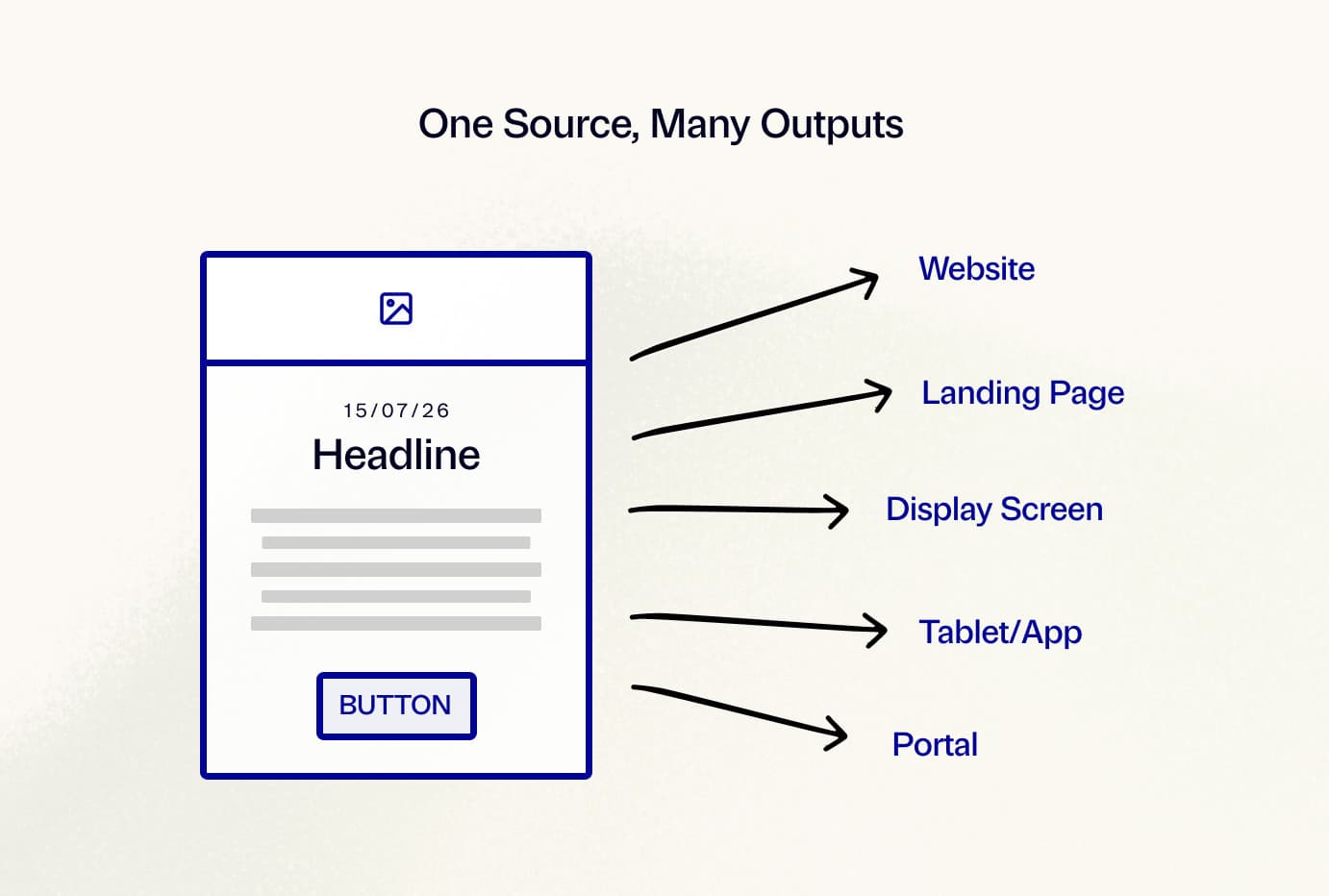
The CMS becomes a structured source of content and data. The front end, whether that is a website, app, portal, display screen or another interface, requests that content through APIs and presents it for that channel.
A page-first system tends to ask, “What content belongs on this page?” A headless system asks, “What content do we manage, how should it be structured, and where might it need to appear?”
For marketing managers and digital leads, that is the important part. Headless is not just a developer preference. It is a different way to organise digital content so it can support more than one campaign, channel or customer experience.
The duplication argument misses the bigger issue
A lot of headless conversation focuses on duplication: traditional CMS platforms make teams copy and paste content, while headless fixes it.
That framing is too simple.
A disciplined traditional CMS build can already handle a lot of reuse. Global blocks, reusable components, structured fields, content references and flexible page modules have been standard practice for years. If a team is copying the same campaign copy across five pages, the problem may be the content model or implementation, not the fact that the CMS is traditional.
The bigger issue usually appears when the business needs the same content somewhere other than the main website.
That might be a customer portal, native app, partner feed, in-store display, tablet interface, transactional platform or future AI-powered content experience. The moment a second front end enters the picture, a page-coupled system can start to strain. Pulling content cleanly into another context often means workarounds, duplicated entry or a rushed content model rebuild.
Headless avoids some of that friction by treating content as structured material from the start. The website remains important, often the most important channel. It is just no longer the only thing the system is designed to serve.
Where headless can be useful
Headless tends to be most valuable when a business needs flexibility across time, channels or systems.
That might mean faster front-end change. Because the presentation layer is separate from the CMS, teams can redesign sections, test layouts, improve interactions or rebuild the front end without migrating the whole content base each time.
It can also support better performance. A decoupled front end can be built with modern frameworks, lighter payloads, stronger caching and edge delivery. That does not guarantee faster results, but it gives the team more control over the parts of performance that affect user experience, search visibility and conversion.
Headless can improve content operations too, when it is modelled properly. Editors can manage structured content around the way the business actually works: services, products, campaigns, locations, team members, resources or offers. The same core content can then appear differently depending on the context, without asking editors to recreate it manually for every surface.
It can also make integrations cleaner. Product data, booking tools, customer systems, inventory, CRM information or transactional platforms do not always need to be forced into the CMS. In a well-planned architecture, the CMS can sit alongside those systems and help compose the experience, rather than pretending to own everything.
None of this means every business needs headless. A stable site with modest content needs, limited integration pressure and no real requirement beyond the website may be better served by a traditional or hybrid CMS.
The useful question is not “Should we go headless?” It is “Where is the current system limiting change, and what kind of change do we expect next?”
What has to be planned properly
Headless benefits are often presented as automatic. They are not.
A headless build can support faster experiences, but performance still has to be designed, implemented and measured. It can support stronger SEO control, but metadata, schema, redirect handling, sitemap generation, crawlable content and canonical URLs still need deliberate work.
It can support a better editorial experience, but only if the content model is built around the way editors and customers actually use the content. If the old page structure is simply copied into a new API, the business gets the complexity of headless without much of the advantage.
Preview workflows also matter. In a headless system, the same content may appear in several places. Editors need confidence about what they are publishing and where it will show up.
Governance becomes more important too. Someone needs to own content structure, field definitions, publishing rules, redirects, analytics, component standards and the relationship between content and design. Without that discipline, headless can create a different kind of mess: more systems, more handoffs and less clarity.
That does not make headless risky by default. It means it should be treated as an operating model, not just an implementation choice.

How to frame the decision
The decision should start with the business context.
What is the business trying to achieve in the next two to three years? What role does the digital platform play in that? Will content live only on the website, or does it need to appear across other channels and surfaces? How often does the team launch campaigns, pages or experiences? How much of that work currently depends on development?
It is also worth asking where the real constraint sits. Sometimes the CMS is the problem. Sometimes the content model is the problem. Sometimes the workflow is the problem. Sometimes the business needs a simpler, better-governed traditional CMS before it needs a more complex architecture.
Headless is strongest when the organisation needs room to move: faster front-end iteration, better performance control, cleaner integrations, reusable content, future channels or a lower cost of change over time.
A traditional CMS is still a reasonable choice when the need is simpler: one primary website, stable content patterns, a small team and limited distribution requirements.
Either answer can be defensible. What matters is that the architecture reflects what the business is trying to do, not which option sounds more modern in a pitch.
The Takeaway
The most useful way to think about headless is not as a technology choice. It is a decision about what shape the system needs to take so the business can adapt.
For a long time, the website sat at the centre of digital presence, and the CMS was shaped to serve it. That model still works for many businesses. But as content starts to move across campaigns, portals, apps, displays, integrations and new customer touchpoints, the system underneath may need to change.
Headless architecture can help by separating content from presentation and giving the business more ways to use what it already manages. It is not always necessary, and it is not valuable just because it is newer. Its value depends on whether the business needs flexibility that a page-first system can no longer provide.
That is why the rebuild conversation should start higher up. Not just what the next website should look like, but what the digital system underneath needs to make possible.
Explore more
The Drive-Thru Test for Website Navigation
What drive-thru menus reveal about clearer website navigation—and how labels, hierarchy and entry context help visitors confidently choose their next step.
Google Wants Your Property Listings
As Google moves further into property discovery, owned websites still matter for buyer confidence and better enquiries.

When Mobile Stops Being One Column
Foldables show where mobile UX is heading: away from one-column layouts and toward adaptive experiences that preserve context, comparison, and decision confidence.