
Mobile has often been treated as the simplified version of the full digital experience: where people browse, scan, compare loosely, or start a task they might finish later on desktop. The more serious decision is often deferred to the larger screen, where there is more room to see the detail and act with confidence.
Foldables challenge that assumption. Not because every business suddenly needs a foldable-specific website, and not because foldable phones are about to replace standard mobile screens. They matter because they make a broader shift easier to see: mobile is becoming a less predictable canvas.
That shift also includes larger phones, tablets, split-screen browsing, resizable windows, and interfaces that need to work across more shapes than a narrow single column. For businesses, the useful question is not “are we ready for foldables?” It is: where does our mobile experience ask people to decide without enough context?
Foldables are not the point. Context Is.
Foldables are not just bigger phones. A larger or divided mobile screen changes the relationship between pieces of information. A product can sit beside its reviews. A list can stay visible while the selected item opens next to it. A map can remain on screen while someone compares locations. This is the useful design idea: context beside action.
Many mobile websites are still built around a stacked journey. The user taps into a product, backs out to the listing, checks a review, returns to the product, scrolls to pricing, opens delivery information, then tries to remember why one option felt better than another. Each screen may be responsive, but the journey can still feel fragmented.
That matters when the decision is more involved than a quick tap. Booking a hotel room, choosing a home builder, comparing self-storage options, or configuring a finance estimate all require enough surrounding information for the user to trust the next step.
Foldables make the weakness of the old model more visible. If a mobile experience only works by hiding the thing the user needs next, the issue is not the foldable layout. The issue is that the experience asks people to carry too much in memory.

What richer mobile decisions Can look like
A better mobile decision surface does not mean putting more content on screen. More space can make a poor interface busier. The value comes from deciding which information should stay close together because the user naturally needs it together.
In ecommerce, that might mean a product listing and product detail working as one continuous view when the canvas allows it. Someone comparing premium appliances, furniture, or technical products may need imagery, specifications, delivery information, reviews, and comparison points close at hand.
The same pattern applies in travel, property, local discovery, quote journeys, customer portals, and booking systems. The interface should protect the relationship between the decision, the evidence, and the next action: map and detail, price and inclusions, calculator and assumptions, record and next task.
The UX shift is from stacking to preserving momentum
Responsive design used to be described mostly as a fitting problem. Does the page fit the viewport? Does the navigation collapse? Does the form remain usable on a phone? Those questions still matter, but they are no longer enough.
The more useful question is whether the experience preserves momentum as the canvas changes. If the user rotates a device, opens a larger mobile screen, uses split view, or returns from another app, does the journey still feel continuous? Does typed text remain? Does the user still understand where they are?
This is where multi-pane layouts, supporting panes, comparison surfaces, and flatter navigation become useful. They reduce the number of full-screen transitions between related pieces of information. A property search can keep the shortlist visible while details change. A booking path can keep inclusions near price and availability.
That does not mean every mobile page needs two columns whenever there is room. Hierarchy still matters. Touch targets still need space. Reading still needs rhythm. The design task is to understand which content relationships carry the decision. The layout should follow the decision, not the device.
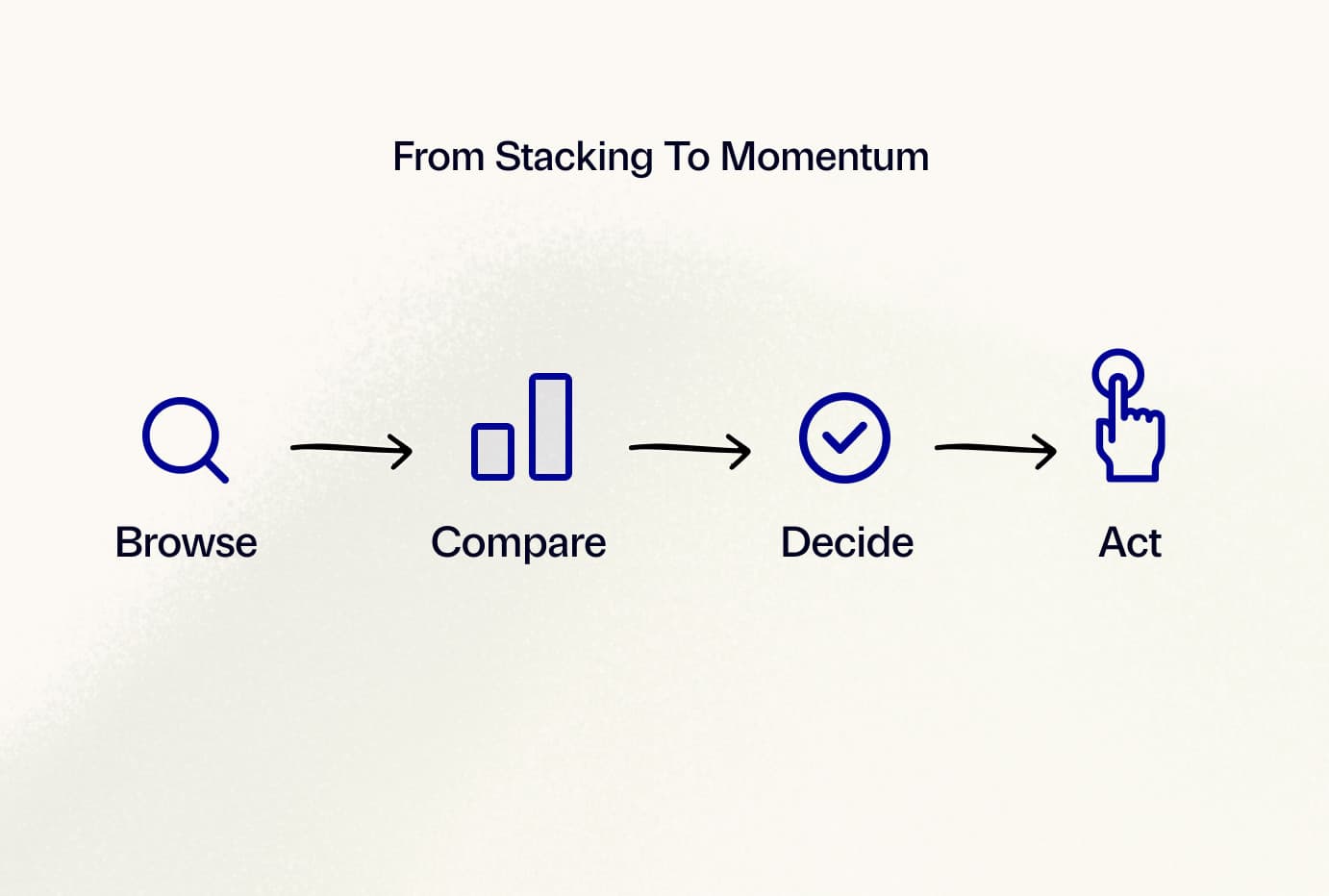
The commercial shift is fewer decisions deferred elsewhere
For many businesses, the commercial issue is not that mobile traffic exists. It is that mobile confidence is uneven. A customer may find the business through search or paid social, browse on their phone, compare a few options, and then delay the real decision until later. Some of that is natural. Some of it happens because the mobile experience never gave the user enough context to move forward.
This is where the foldable conversation becomes commercially useful without turning into a conversion-rate promise. Richer mobile layouts may support clearer landing pages, better self-qualification, more useful enquiry behaviour, and fewer abandoned evaluations, but only where the journey genuinely benefits from comparison, proof, guidance, or continuity.
A campaign journey for a property development, resort stay, high-value product, or specialist service often needs more than a headline and a form. If inclusions, location, imagery, availability, proof, and next steps are constantly separated on mobile, the campaign may be driving attention into an experience that is not helping people decide.
Measurement should reflect that nuance. Enquiries, bookings, demo requests, and purchases still matter, but richer journeys also deserve attention to comparison interactions, return visits, form quality, call quality, and post-lead fit.
The practical response is adaptive, not device-specific
The sensible response is not to build a separate foldable experience for every website. Foldables are still a minority device category, and browser and platform support for fold-specific features continues to mature.
Start with a strong mobile foundation. Make sure the single-column experience is clear, fast, readable, and complete. Then look for the places where a larger or segmented canvas can support the decision rather than merely stretch the layout.
That means designing around content relationships instead of device names: product plus proof, list plus detail, map plus options, form plus guidance, pricing plus comparison. These relationships can be expressed differently across standard phones, larger phones, tablets, foldables, and desktop, but the underlying design question remains the same.
It also means testing beyond a small set of breakpoints. Resize the window. Rotate the device. Use split view. Return from another app partway through a form. Compare two items. The goal is to find the points where the experience loses context, resets the user, or makes the next action less certain.
The takeaway
Foldables are not a platform race most businesses need to join. They are a useful reminder that “mobile responsive” can no longer mean stacking everything into one column and hoping the journey still makes sense.
The better question is not whether your business is ready for foldables. It is where your mobile experience is still too narrow for the decision you are asking people to make.
Explore more
The Drive-Thru Test for Website Navigation
What drive-thru menus reveal about clearer website navigation—and how labels, hierarchy and entry context help visitors confidently choose their next step.
Google Wants Your Property Listings
As Google moves further into property discovery, owned websites still matter for buyer confidence and better enquiries.

Headless Architecture Is Really About Adaptability
Headless architecture separates content from presentation, helping digital platforms adapt across websites, campaigns and customer touchpoints.